Category: Blog

  • On the books I’ve been reading in October

    On the books I’ve been reading in October

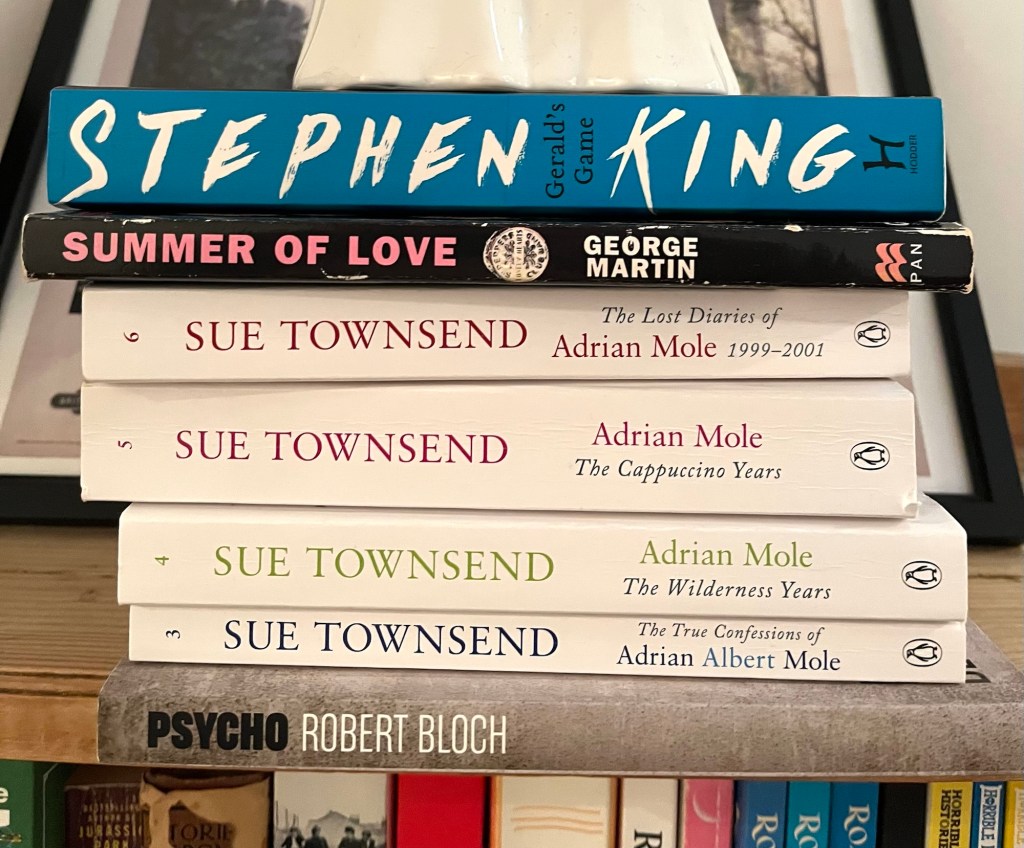
    24th October, 23:38. Soon, the clocks will turn back. Truly, the most magical night of the year. Here you go, an hour, gratis. The wind is literally shaking our living room. The cats are shrieking and chasing each other like they know what’s about to happen. I actually feel wide awake. I am on the right side of the flu, after two days off work. My sleep schedule has been erased. On Thursday, I fell asleep at 17:00 listening to Jane Eyre and woke up at 19:12. Helen Burns, I feel you, girl! Tonight is my opportunity to catch up on some reading. I have been convalescing with Gerald’s Game by Stephen King. This feels good: staying up late with a scary book. As the kids might say, it’s giving 127 Hours. Those kids! They say the craziest things. I have only read one other Halloween adjacent book this October, unless everyone is dressing up as Adrian Mole next Saturday, in which case I’ve read way more.

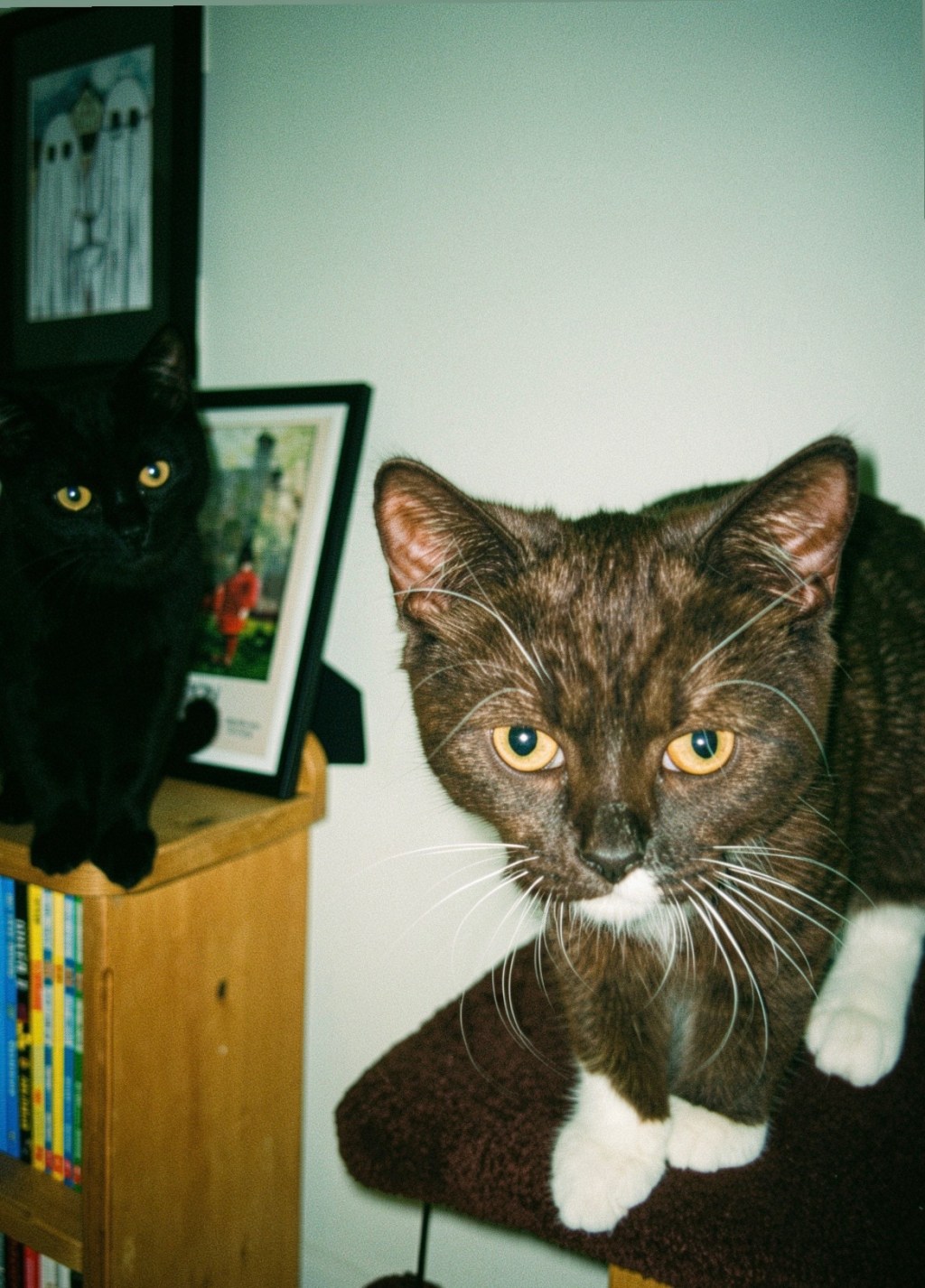
    31st October, 4:07. Soon, they will break down the door. I have no doubts about it. Just my luck! I can’t decide if it’s better to wait in the kitchen, or here in the hallway by the door. But then the first Adrian comes through and we’re standing face to face. He nods apologetically and worms past me, then through into the living room. A few more Adrians follow him. Somehow they have not woken Alice, or disturbed the cats too much, although when I find a line of Adrians on the settee, I see Scrooge nuzzling between a set of legs, trying to get cosy. This is unusual: as a rule, Scrooge is scared of all visitors. ‘Is it trick or trick?’ I ask, searching for some reason why the Adrians have appeared. But one of them starts on about the Norwegian leather industry and I realise we are lost. I say, ‘You’ve invaded my brain.’ I wince. Their faces are so readable, I could hardly look away if I wanted to. It’s hopeless.

    ‘Blueprints’ by Unpeople from their 2026 debut album. This is a song I have listened to a lot in October.

    Psycho by Robert Bloch (1959)

    If you know me you know that Psycho is my favourite thing ever, more than Twin Peaks, the Beatles, Daphne du Maurier, or even probably chocolate in all its mellifluous forms. I first read Psycho by Robert Bloch last Halloween. It is impossible not to compare it to the film, and that is part of the fun. It it strikingly different in parts, but the film lifts certain scenes wholesale, like the ending:

    She sat there for a long time, and then a fly came buzzing through the bars. It lighted right on her hand. If she wanted to, she could reach out and swat the fly. But she didn’t swat it. She didn’t swat it, and she hoped they were watching, because that proved what sort of person she really was. Why, she wouldn’t even harm a fly. (pp. 185)

    Well, maybe not wholesale. The perspective is different. I watched an interesting and impassioned argument for the book a while ago, linked below. I like the book, especially the opening movement, which is the biggest departure from the film (it’s the other way round, of course, but anyway). The famous shower murder is different. The irony is not sad, as in the film, but callous: “Mary started to scream… a hand appeared, holding a butcher knife. It was a knife that… cut off her scream. And her head.” (pp. 39). The book has none of the film’s elegiac quality, but it is economic and frightening in a different way.

    ‘Pulp Today 44: Robert Bloch and Psycho’ by David Avallone

    The True Confessions of Adrian Mole by Sue Townsend (1989)

    This is a hodgepodge book. But a hodgepodge can be nice: just look at the humble stew, people! True Confessions is split into three main sections: a collection of Adrian Mole pieces, distinct from the diary entries, but a welcome change of pace after reading Secret Diary and Growing Pains back to back; a selection of travel writing and articles by Sue Townsend, including a long section about a trip to Mallorca which was my favourite; and finally, the highlight of the whole book, an Adrian Mole style diary by one Margaret Hilda Roberts, aka the Witch-King of Angmar. Now, if that sounds like a lot, it is, and this is probably one for Mole completionists. I hate it when people say that about something I haven’t read, though. Oh, so this is just for the fans? I’m gonna read it even harder, then.

    Adrian Mole: The Wilderness Years by Sue Townsend (1993)

    Having read the majority of the Mole books now, I’d say this is the underrated entry. We join Adrian in Oxford in his early twenties. He is living with (but crucially not going out with) Pandora. He’s working for the Department of the Environment under the officious and adulterous Mr Brown. A good portion of the novel is devoted to Mole’s struggle with his work-in-progress novel Lo! The Flat Hills of My Homeland:

    6:00pm. Sink still blocked. Worked for three hours in the kitchen adding vowels to the first half of my experimental novel, Lo! The Flat Hills of My Homeland, which was originally written with consonants only. It is eighteen months since I sent it to Sir Gordon Giles, Prince Charles’s agent, and he sent it back, suggesting I put in the vowels. (pp. 19)

    The novel moves from Oxford to Leicester as Adrian loses his job and his room. This move means we get back to what the Mole series is all about: the relationship between Adrian and his mother. There is a very touching moment when Mum reads Adrian’s manuscript, derides it, but then when Adrian cries to the point of dehydration she takes back what she said and consoles him. There are some lovely details in his ‘home’ section: “… the encrusted neck of the HP sauce bottle…” (pp. 177). I think I like this book in particular now, because it is the last time in the series Adrian is younger than I am. That won’t be true for long, mind. Translation: I’m nearly fucking thirty.

    Adrian Mole: The Cappuccino Years by Sue Townsend (1999)

    The Cappuccino Years was serialised on Radio 4 recently (it might have been a repeat) and I listened to it walking through the park, hungover. I ended up on the beach: one of the things I like about living where we live is you’re never far from a tree, or a pier. Cappuccino Years is the turning point in the series. Adrian is an adult.

    I have reached my prime without noticing it or enjoying it. I am only a few short decades away from being unable to cut my own toenails. (pp. 129)

    This is the point in the series when Townsend makes decisions which lead to various dead ends. (Offally Good being a prime example – a funny idea that never takes off.) But such is life: you can’t turn back the clock. The most important part of the book is the addition of William, Adrian’s five-year-old son. Adrian Mole: single parent. This is the heart of the book. At one point in the story, Williams ends up in hospital, having lodged a coffee bean into his ear.

    When the decision was made to operate I turned to my mother and said, ‘I hold Ivan Braithwaite responsible. It was he who introduced the coffee bean to Wisteria Walk.’ (pp. 249)

    The clincher is this: on waking from his operation, William cries for Adrian’s mum, Pauline, and not Adrian. “I now realise that I’m not the most important person in his life, as he is in mine.” I found this section very moving. As a whole, though, I don’t think Cappuccino Years keeps the promises made in its long opening section, in which Pandora is elected as an MP, becoming one of Blair’s Babes. In fact, the novel misses Pandora. Life has gotten in the way. A new day has dawned, has it not?

    New Labour anthem: ‘Things Can Only Get Better’ by D:Ream

    The Lost Diaries of Adrian Mole, 1999 – 2001 by Sue Townsend (2008)

    This book is a headache for anyone with a penchant for continuity. Published after the next book chronologically, Weapons of Mass Destruction, The Lost Diaries contradicts parts of that book and the proceeding books. For example, Ivan Braithwaite dies on honeymoon in Weapons, but in The Lost Diaries, he’s around and kicking long after his honeymoon, worrying away in his computer nook. But the Mole books are a bit like this overall: they can be messy, but in that way they are reflective of life. But there is a repetitious quality to The Lost Diaries which irked me. Adrian wonders, “Are pensioners to be my albatross? I can already feel Mrs Wormington’s liver-spotted hand around my neck.” (pp. 72). This is a thought that we have seen word for word in a previous book. The standout in this book is Pamela Pigg: one of Adrian’s more unfortunately named girlfriends, and a cousin (not literally) to the more rounded and interesting Marigold Flowers.

    Summer of Love: The Making of Sgt. Pepper by George Martin (1994)

    Man cannot live on Mole alone. This book was a charity shop steal at £3. I first heard about it on Your Own Personal Beatles and I’ve wanted to read it ever since. In short, it is the making of Sgt. Pepper from George Martin’s point of view. What it reveals about George Martin’s pomposity is interesting. There are interesting moments of moralising, too: “Drugs and alcohol tend to be abused when people dislike the reality they are living through. Sorry, but it’s the truth.” (pp. 111). It’s the ‘sorry’ that’s particularly biting. Well, sorry, George, but there’s a bit in this book where you say Edward Lear wrote Jabberwocky. It was Lewis Carroll, you idiot! This is a very quotable book, bottom line.

    Every time I go on about the primitive state of recording technology in the mid-sixties, I feel like Baron Von Richthofen describing the Fokker Triplane to a group of Concorde pilots. (pp. 22)

    Despite this flirtation with the Partridge-esque, there are moments of luminosity:

    For John, the vision was always better than the reality… That was his life. (pp. 24)

    Reading this book reminded me of a fascinating documentary from 2007, which I watched at the time, aged ten, in which contemporary bands remake Sgt. Pepper using the original recording equipment. The Kaiser Chiefs section is almost unwatchable. Ricky Wilson cannot sing ‘Getting Better’. I’ve included a link to the doc below.

    Gerald’s Game by Stephen King (1992)

    My first Stephen King. Go figure! I wasn’t sure if I would finish this book. I came to the halfway point and wondered if I was engaged at all. Then I went at it in one big chunk. I was sold. The premise is a peach: married couple retreat to their summer lake house, introduce handcuffs to spice things up in the bedroom, but before things can get going the husband has a heart attack, leaving our main character handcuffed to the bed, with the keys at the other end of the room. Crucially, this is pre-iPhone. There’s no asking Siri to call 911, or anything like that. My least favourite part of the novel was any business around getting a sip of water, trying to manoeuvre on the bed, or basically anything to do with trying to escape from the situation. Fortunately for me, King is not very interested in this either, and the novel becomes a meditation of memory, prelapsarian guilt, sex, and fear. Unfortunately, there is a fifty page epilogue I could have done without. It should have ended with the car: I’ll say no more.
    ‘Black Hole Sun’ by Soundgarden. A terrifying music video for Halloween, and also a song that connects to Gerald’s Game – get it?

  • On the books I’ve been reading in September

    On the books I’ve been reading in September

    September was a funny one reading-wise. I didn’t feel like I got into the swing of anything, really. It could be said I was bogged down by too much narrative non-fiction, and although I enjoyed those books on the whole, I was starting to think like a long piece in The New Yorker. I developed an inner vocal fry. By the end of September, I was in dire need of fiction. And this is the time for fiction. The nights are drawing in; let’s hunker down!

    The reset part of September went well. I bought new glasses and new sunglasses. Sunglasses: green lenses, pink frames. Wicked maintains its chokehold on the culture. Last Saturday I had the flat to myself, and after noodling around, I went out for a long walk with Shirley Jackson and my sunglasses. The sky was bright and the clouds were pea green. They were enormous.

    I’ve kept this brief, not because I think recent posts have been too long (vanity, all is vanity), but I’m tired. It’s past my bedtime. Let me say this though. I feel positive about October. In a couple of weeks, Best British Short Stories 2026 is published by Salt. I am very proud to say that one of my stories, ‘Why Do You Let Me Lie Here Wastefully?’, is included this year. I have taken that Monday off work, just to sit with my own thoughts, drama queen that I am.

    ‘This Is the Day’ by The The (1983). A song I listened to on a loop in September.

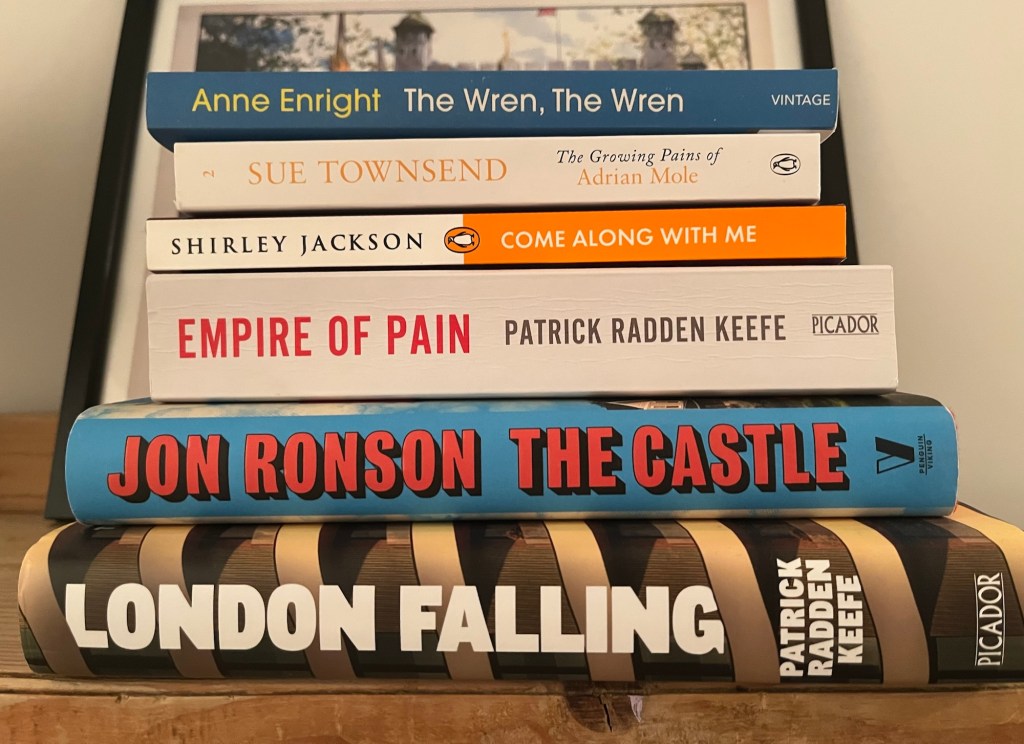
    The Growing Pains of Adrian Mole by Sue Townsend (1984)

    The ending to Growing Pains is one of my favourite endings to a book ever:

    Thursday June 2nd

    My parents went to see a family therapist last night. During their absence Pandora and I indulged in extremely heavy petting; so heavy that I felt a weight fall from me. If I don’t pass my exams it won’t matter. I have known what it is to have the love of a good woman.

    One of the many joys of Adrian Mole for me is wondering to what extent he is self-aware. I think it’s probably more than we give him credit for. The texture of this book is different to Secret Diary: the entries are longer, and the story is richer in plot and detail. The best reversal for me was Adrian embracing his baby sister, Rosie, rather than rejecting her, which might have been the obvious comedic option.

    London Falling by Patrick Radden Keefe (2026)

    I gave in to the hype and the absurdly long subtitle (A Mysterious Death in a Gilded City and A Family’s Search for the Truth) and bought the book. I enjoyed the analysis of how London metamorphosised between the eighties and noughties. I might have enjoyed reading more about that. I never felt he got to grips with the city, in the end. But this is a chilling story.

    The Castle by Jon Ronson (2026)

    I came away disappointed by The Castle, although there were stand out chapters for me. It was the story of Chris Mark and his castle that I found uninteresting. Awful things are happening in the castle, but I felt unengaged. The book was at its best focusing on YouTube, I thought.

    Empire of Pain by Patrick Radden Keefe (2021)

    The opening section of this book – ‘Patriarchy’ – had me gripped. But there is a lack of dynamism to Radden Keefe’s writing. The story spans decades. I never felt that this change was communicated on the page, other than literally. It felt staid.

    Come Along with Me by Shirley Jackson (1968)

    Shirley Jackson remains one of my top short story writers. Why would you suffer through hundreds of pages of Lolita when there’s ‘A Cauliflower in Her Hair’?

    The Wren, The Wren by Anne Enright (2024)

    I read, I read The Wren, The Wren back in 2024. I liked it just as much in 2026, perhaps a little more. I like the way Enright obfuscates. I love her motifs. Like Adrian Mole, Nell self-ironizes: “I am currently obsessed by light. It is hard to turn this into cash. An obsession with light does not commodify.”

    ‘Alone Again Or’ by Love (1967). Another September banger for me.
  • On my twenty most streamed songs: Gillian Welch to Fontaines D.C

    On my twenty most streamed songs: Gillian Welch to Fontaines D.C

    I’m saying… I’m a man who streams music who dreamt he was burning CDs, but now the dream is over and the man who streams music is awake.

    20. Revelator by Gillian Welch

    I listened to this one Gillian Welch track repeatedly on the walk to work in late 2025. It became clear to me that January would be filled with uncertainty. ‘Revelator’ reflected… something. “Time’s a revelator.” She’s bang on.

    19. Gretel by Alex G

    One of two appearances by Alex G on this list. Every part of ‘Gretel’ is gripping to me. I pressed play as the bus climbed over the bridge on Squires Gate. When the sunset revealed itself over the sea, this song was the perfect soundtrack. The album House of Sugar is Alex G at his emotional, eerie best.

    18. Desperado by The Eagles

    It’s incredible to me that no one has attempted an Eagles jukebox musical. I would definitely watch the slime tutorial on YouTube.

    17. Thunder Road by Bruce Springsteen

    Ollie Watkins receives the ball from Cole Palmer and hits it into the bottom left corner of the net. It’s suddenly clear: there is no time for the Dutch to respond in kind. Time has in fact stopped. But then full time arrives. I tell Alice that I will be sleeping in the spare room tonight. I am too awake. I play ‘Thunder Road’ full pelt through my earphones.

    16. Tom and Mary by Ben Folds Five

    In sixth form, a girl asked what sort of music I was into. The album AM by Arctic Monkeys was very big at the time. I said I was into ‘piano rock’, and asked if she’d heard of Ben Folds Five. They represent to me a sort of queasy nostalgia (tautology alert?), but in my opinion, they still rule.

    15. Expert in a Dying Field by The Beths

    This is one of the catchiest tracks by one of my favourite contemporary bands. If you haven’t heard The Beths I strongly suggest you check ’em out.

    14. Brighton Rock by Queen

    One Christmas not long ago, Alice bought me Sheer Heart Attack and A Night at the Opera on vinyl. Queen are a Christmas band to me. I have a very strong visual memory of waiting at a set of temporary traffic lights opposite a Greene King pub, on my way to the bus, and listening to the start of this album. I listened to this album a lot on the exercise bike, so when I hear this I feel well exercised and worn out, much like the cover.

    13. Ain’t No Crime by Billy Joel

    In my early twenties I worked as a receptionist for a physiotherapist and this was my alarm in the morning. It’s quite a mad song to set as your alarm, music -wise, but then the lyrics are sort of route one: “You’ve got to open your eyes in the morning, nine o’clock coming without any warning, and you gotta get ready to go.” If I hear it now, I feel a bit sick. ‘Ain’t No Crime’ only makes it onto this list because it was the first thing I heard every morning for about a year.

    12. Rockin’ All Over the World by Status Quo

    The still point in my turning world.

    11. Don’t Think Twice, It’s Alright by Joan Baez

    As time goes by, I like this cover less, but I listened to it a lot at one point. I do wonder how much water damage my iPhone has sustained over the years, as I sing along to Bob Dylan songs in the shower. My suspicion is that I listened to this song when writing a particularly moody story, probably about a break-up, but I can’t remember anything specific.

    10. Jesus Was a Cross Maker by Judee Sill

    I distinctly remember hearing this song for the first time on the sixty eight bus into Blackpool one morning, on my way to work at the Pleasure Beach. It is crazy to me that all that was only a year ago. It was a rare instance of listening to the song immediately again, and then again. I just think it’s beautiful – absolutely.

    9. The One by The Lemon Twigs

    I am not sure if I like The Lemon Twigs, although I feel I probably should. Their songs meant a lot to me during that period after university, when I was living with my parents again. I haven’t listened to their latest: maybe it’s time, as a former Twiglet, to give the band another go.

    8. Runner by Alex G

    Alex G’s second appearance on this list. “I like people who I can open up to, who don’t judge for what I say but judge me for what I do… My runner, my runner, my man.” In my head this is a song about masculinity, or that feeling of wanting to achieve something ineffable. There’s an ache to it. It’s a perfect song to me.

    7. The Boy with the Arab Strap by Belle and Sebastian

    I listened to this song on repeat when I was writing my sequel to Malory Towers (we follow Darrell and Sally to St Andrews), which I then sent to a Malory Tower blogger, who was very kind about it. If anyone wants to read it, give me a shout, it’s definitely something.

    6. Mona Lisa and Mad Hatters by Elton John

    A couple of years ago I spent many evenings with an elderly downstairs neighbour, and I spent a good amount of time in my flat fixing or setting up his electrical appliances. He went through several CD players. He died last year. When I started to visit him downstairs (as he said – just to check that he was still breathing) I became fixated on this song, for some reason, and listened to it again and again.

    5. Seven Seas of Rhye by Queen

    Queen again. I like it when Freddie goes slightly northern singing “…and come out alive…” But maybe that’s just me.

    4. Belinda Says by Alvvays

    A beautiful song by Alvvays. “Moving to the country, gonna have that baby.” I could listen to this all day – and did at one point.

    3. Love Takes Miles by Alex Cameron

    “Love will make you fit it all in the car.” I’m getting married next year. My partner is part of a local women’s choir and she has asked if they would perform at the wedding. We’ve asked for ‘Love Takes Miles’ – reader, if that happens, I will cry for about a thousand years.

    2. I Can Tell a Lie by Peter Allen

    This song takes me back to the trampoline at the back of my parents’ garden (long gone to the tip). In the summer before university, I would lie on the mat alone, listening to music I had downloaded onto my iPod nano. I was obsessed by finding an album that could be mine, that no one else would know. Tenterfield Sadler became that album for me, and this song was my favourite.

    1. Bug by Fontaines D.C

    If I was writing a list of favourite songs, I don’t think this (or any Fontaines song) would make it on, but here we are. Like ‘Revelator’ by Gillian Welch, I would listen to this track on the way into work, last year. It is a perfect energiser. If I listened to ‘Bug’ three times down the street, I felt I could face anything.

    So, here endeth my list of ‘most streamed’ songs. I didn’t choose it, but of course in a way I did. This isn’t a post about the ethics of the streaming giants – it is just a fun list – but for the record, I Bandcamp, I buy CDs. But my generation’s MO is streaming: we have been weened on the subscription service, and it has served us good and bad.

  • On the books I’ve been reading in August

    On the books I’ve been reading in August

    At the start of August I took a week off work. There was convalescence in the air! I did have a cold coming on. We bought new folding chairs. I bought sticks of rock: mint, rhubarb and custard, and one that was simply sugar flavoured. The rock is now slowly softening in the kitchen cupboard. By Christmas, the rock will have hardened again, and could cause real damage. On day one we sat on the right side of the pier. On day two we sat on the left side of the pier. There was a high concentration of families on the left side. Waves of schadenfreude! Stressed parents cajoled and negotiated. And there we were: two freewheeling dinks. Home, I had a luxurious nap but awoke with painful sunburn. Without thinking, I jumped into a cold shower. I emerged looking like Bagpuss.

    On the Thursday we went to Liverpool. This was the day a 90-second power failure at an operating centre caused major disruption on the train lines. We were none the wiser. We enjoyed another pint and debated whether to walk the short distance to the Lego Store to buy the newly release E.T set. We ended up in Bond Street. Alas, no timeslip. Earlier that day we had been to The Beatles Story on Albert Dock. We walked down the street with four “I Love [insert Beatle here]” badges on our rucksacks. Alice picked two. I picked two. It was only when we left News From Nowhere that we saw that the Trainline app was red with cancellations. A plan was formed in Fitzgerald’s Irish Bar. We would take the hit: Uber-it. I was determined that this disruption would not spoil the day. I am not sure if I did much to reassure Alice about the £100 she was about to blow (the KLF would have burned it, so there is that) on an Uber, but I do remember sitting in the corner of that Irish pub, with James Joyce and Roy Keane in black and white above and behind us, and sharing a moment. This is the shit situation. But that’s fine. Because we’re lucky: and together. We bought Lego E.T by the way.

    At The Beatles Story, Albert Dock, August 2026.

    The KLF: Chaos, Magic, and the Band Who Burned a Million Pounds by John Higgs (2013)

    This was my beach read. And what a perfect beach read. The ideas had space to breathe. If I had read this on the bus, on the way to and from work, I do not think I would have got as much from it. It didn’t hurt that I felt more relaxed after a day away from the office. In this book, John Higgs tells the story of the KLF, the band who burned a million quid. It is clear from the start that this is not going to be a straightforward bit of music journalism. In fact, there is very little about the actual sound of the KLF in the book. ‘Drummond and Cauty (the KLF) stumbled mapless through their own stories, taking and using whatever they felt useful, so that is the approach we shall take as well… Here, then, is a story that the cast were not told they were in.’ (pp. 19). I’m hooked! The story that unfolds – or folds in and around the spectacle of the KLF – is fascinating and rich. I saw my aunt recently and asked if she knew about the KLF, because I’d just read this great book about them. She said they used to dance to them. My mum said she remembered how much she liked the ‘Justified and Ancient’ song and video with Tammy Wynette. The KLF spoke directly to my parents’ generation, but by burning a million quid they gave birth, magically, to the wave of 21st Century recessions that have defined my adult life.

    ‘Justified and Ancient’ by The KLF (1991)

    Picnic at Hanging Rock by Joan Lindsay (1967)

    I am also pleased I read Picnic at Hanging Rock on holiday. I left forty pages unread as I went to bed, then got up at about three in the morning to finish it in the spare room. It felt like a throwback to staying up too late as a kid to read (or play on the Nintendo DS). It was also like I had been pulled back to the book by an unseen but powerful force, a presence I had probably, wittingly or not, invited in. Fitting! Joan Lindsey presents the novel as a true account. On Saint Valentine’s Day, 1900, a party of school girls from Appleyard College set out to enjoy a picnic beneath Hanging Rock. Three of the girls vanish. A teacher vanishes. One girl is found but she has changed somehow, and instead of shedding light on the mystery, her reappearance only deepens it. Lindsey never reveals to us what happened on hanging rock. In his essay, ‘The Eeriness Remains…’, Mark Fisher points out that 14th February, 1900, was a Wednesday, not a Saturday. But this is not an error per se. There are reasons for Lindsey setting this story on Valentine’s Day and in 1900. In my mind, the novel is dealing with fin de siècle. Mrs. Appleyard represents the death of the old century, and by stepping behind the monolith on hanging rock, Miranda and company represent the next step into a new century. Just as importantly, Picnic at Hanging Rock is a beautifully written book. It is perfectly constructed and executed. It is held together by an extraordinary combination of fine detail and complete mystery. There is lots I’d like to say about this book in a longer post.

    Exterminate/Regenerate: The Story of Doctor Who by John Higgs (2025)

    Docky Who. The still point in my turning world. But that’s not even half true. My relationship with Doctor Who is a bit complicated, and that’s probably typical. I remember my mum’s excitement when the programme returned in 2005. I remember a big billboard in Preston: Christopher Eccleston and Billie Piper and the new logo. I think Mum actually gasped. For five years, until the dawn of Matt Smith, Doctor Who was a huge part of my life. It formed my imagination in new ways. But then it changed, and because I was changing too, I let it go on without me. It was an amicable split, I think. The fondness remains, though, so this book by John Higgs, which I bought in Liverpool and started during the taxi ride home, was a lovely read. The central idea that the Doctor thrives because they lack a single ‘creator’ is compelling. Doctor Who occupies a collective ideaspace, rather than belonging to one person, or even a select group of fans. Exterminate/Regenerate is a brilliantly pacey read, too. John Higgs knows how to keep you reading, in a very similar way to Jon Ronson, or Caitlin Moran. There is an engaging idea or piece of Docky trivia on every page. (Sidenote: I found it odd that Higgs didn’t mention ‘Doctorin’ the TARDIS’, given the KLF connection.)

    TV trailer for the 2005 reboot of Doctor Who.

    The Commitments by Roddy Doyle (1987)

    I was thinking about characters existing in ideaspace, becoming as real as any real person, when I started The Commitments. Jimmy Rabbitte is as real as milk, especially in those first few pages, when the idea of the band and Dublin Soul is forming. I read The Barrytown Trilogy for the first time in 2023. I was working at Blackpool Pleasure Beach at the time. I would go out on my lunch break and sit beside South Pier and read. Lots has changed since then, and I think I liked different parts of The Commitments this time. I had also forgotten how much of the film is not in the book. I found the sections in which lyrics are repeated on the page pretty obnoxious, to be honest – call me no fun, but that’s me! But I got more out of the book as a whole the second time round. I like Jimmy Rabbitte. He changes his world and then it snaps back to normal; so it goes. I was going to read The Snapper straight after, but I couldn’t face it. I think I like this style less than I did three years ago, or maybe at the moment I need something a bit denser (literally, I think, more words on the page – I don’t mean The Commitments lacks depth). It was at this point my holiday finished. It was back to work time.

    The Secret Diary of Adrian Mole Aged 13 3/4 by Sue Townsend (1982)

    If there is such a thing as a perfect novel, I think this is it. To quote Limmy’s impersonation of Richard E Grant reviewing Star Wars: The Rise of Skywalker, ‘I laughed, I cried, I fist-pumped the air!’ Reading Adrian Mole, I was reminded again of ideaspace and fictional characters existing as real people. I have spent the last week in Adrian Mole’s head. I have listened to Sue Townsend’s Desert Island Discs (a good one). I listened to the Backlisted episode on the book (I don’t usually like that podcast, but I wanted another Mole fix). Nina Stibbe is the guest and gives an expert analysis on Townsend’s technical tricks. I have pushed the book onto Alice, and now my sister has asked to borrow it. I find it interesting how lots of my thinking in August has been tied to iconic figures from my parents’ past: The KLF, The Doctor, and Adrian Mole. I don’t know if I could point to today’s equivalents, but perhaps that is cynical. If someone asked for my favourite book now, I think I would say The Secret Diary of Adrian Mole. I genuinely think the last time I laughed out loud when reading was Charlie Brooker’s columns (collected in Dawn of the Dumb) when I was Mole’s age.

    ‘Profoundly in Love with Pandora’ by Ian Dury (1985).

    Stormbreaker by Anthony Horowitz (2000)

    I was looking for something like Stormbreaker, Friday before last. I think it’s true that you shouldn’t reveal too much about yourself online, so I will simply say, it was a challenging week in the office. I wanted not only an easy read but something that took me back to childhood. It did the job for the most part. I liked that Alex Rider does not kill anyone with a gun, although he commits manslaughter several times, once via giant jellyfish. The first Alex Rider novel focuses on the death of Alex’s uncle (quite funny how he’s referred to by Alex as Ian Rider and never uncle, or even just Ian, throughout) and Alex’s induction into the world of freelance teenage spying; his first mission is to investigate billionaire Harold Sayle and his Stormbreaker computers, which he plans to gift to every school in the UK (bit sus!). Horowitz’s ability to move a story at all costs is astonishing, and I do think he has a genius for set-up, execution, payoff. I owe Horowitz a lot. As a teenager I was an avid Midsomer Murders fan, and in the mould of Adrian Mole, I experienced a sexually awakening during a steamy scene in a barn, after murder via combine harvester.

    Blurred Edges: Short Stories by Mike Fox (2026)

    This is one of only a few books I pre-ordered this year. I am a fan of Mike Fox’s work, and I like to think he’s one of my writerly friends online. I had the privilege of reading his novella (due to be published later this year) about Satan’s Actuary. I have also read Mike’s previous short story collection Things Grown Distant, published by Confingo. The focus of the stories in Blurred Edges – for me – is the potential for unease, or even violence. The story ‘Dr Takotsubo, and My Heart’ is about a man dealing with the end of a romantic relationship with a work colleague. Nothing bad happens (other than the narrator’s simulated cardiac arrest caused by emotional distress) but there is something in the voice that leads you to believe not all is well in the world, and in particular his world. The edges are blurred: the injections of dialogue between the narrator and his erstwhile girlfriend are amicable enough, but then his histrionics and verbosity suggest to me that this man is not well, and it’s not just his heart. I think I like this story because it is unresolved. Another highlight for me was ‘The Fun Police’, which has a Tales of the Unexpected feel. It would be nice to delve into each story. I was thinking of writing posts about short story collections, because every time I include them here, I feel like I’m rushing. Maybe Blurred Edges would be a good one to start with, but in the meantime, I would advise you to check this out.

    So, that’s August, or very nearly. I’ve also listened to a lot of good, new (to me) music this month. Here is one track I have been listening to a lot.

    ‘Pin Up Boys’ by new indie rock darlings Westside Cowboy (2026).
  • On the books I’ve been reading in July

    On the books I’ve been reading in July

    Handover: complete. I am outta office for a whole week. We have no plans, apart from watching films, reading, and going to the pub. Bliss. We are also going to take advantage of the seaside which is literally on our doorstep. But I’d like to take you back, all the way back to the start of July. Thanks to everyone who read my post about Our Mutual Friend. I had some lovely feedback, and I’m pleased that I put the time and effort into that piece of writing. This post might feel like a return to the décontracté, but it is, I assure you, as tight as a screw. July was a fun month. The highlight was seeing CMAT in Scarborough on the 18th. Alice drove coast to coast twice in as many days, and I continued to live my best life as a passenger prince. I have promised that I will learn to drive before our wedding next year. I have this image of slapping down my license on the top table, but that feels perhaps a little too demonstrative. CMAT was fab. Scarborough was ace. And the day after, we saw Alice perform with her choir. It was a top weekend. I almost forgot about the World Cup. It was sour. It all felt very sour. I really wanted the Ronaldinho cup from McDonald’s, and I was instead sidled with Lamine Yamal. So it goes. Here’re the books I started and finished in July. I also picked up and put down quite a lot. I read the first few chapters of The Hobbit and came across the best line written in English: “The washing-up was so dismally real…”

    The music video for ‘Stay For Something’ by CMAT from her 2023 album Crazymad, For Me.

    The Shortest History of Ireland by James Hawes (2026)

    One of my most lucid reading memories is starting and finishing James Hawes’ The Shortest History of England on a flight from Rome to Bradford, two years ago. For the whole of the holiday it had stayed on my bedside table, unread. It was a poor choice of book. Why return to dreary England when in Rome? I had also brought The Bee Sting by Paul Murray, but who wants to read such a thick novel after walking around touristing in the Italian heat? I was ready for a good read on the flight home. By the time we landed in England, I did feel a bit like, not more of fucking this – not more England. I have also read James Hawes’ The Shortest History of Germany, which is perhaps the masterpiece out of the three. I read The Shortest History of Ireland, the newest entry in this series, over one day at the start of July. “Read in a day. Remember for a lifetime.” The trouble is, when I read that on the back of a book, my brain decides that if I don’t finish it in one day, I have failed somehow. I probably should have taken my time with this. But that’s not to say I got nothing from it. I learnt lots of things I didn’t know, but more importantly it made me realise how little I do know about Irish history.

    The Fairy Feller’s Master-Stroke by Mark Chadbourn (2002)

    I picked up this book (signed!) by Mark Chadbourn in Panda’s Books and Records in Levenshulme, back in May. There is no text at all on the cover. Instead: a part of the titular painting by Richard Dadd. It’s a striking book, and that’s before you’ve started the story. Danny is troubled. He is ruminating on his childhood. Those sticky summer days. He is terminally troubled by the adult world. He has escaped into drugs – at one point in the narrative, he almost dies from an overdose. But his greatest escape is into The Fairy Feller’s Master-Stroke and the story behind the painting. Murder, mysticism – madness. Patricide. Its misdirections are satisfying, even emotional. Chadbourn has something to say about the bridge between childhood and adulthood. The voice of Danny is totally compelling, always intriguing, and dreadfully unreliable. Seek this out, I’d say.

    A Freewheelin’ Time by Suze Rotolo (2009)

    I would be surprised if this wasn’t one of my top reads of the year. I have been going through a big Dylan phase. The remarkable thing about this book, a memoir of Suze Rotolo’s late teens and twenties, is that it refuses to become a book about Dylan. I was completely gripped by the section in which Rotolo leaves New York for Perugia, Italy. By this point, her relationship with Dylan is fizzing with love and import. They’re long distance now, though. Things change. It’s a powerful narrative and Rotolo tells it so well. There are particular sections I love about her family, especially her mother:

    Now and then in the evenings, my mother would talk about her life, about death, and about philosophical issues. These occasions frightened me profoundly. I felt she was speaking not to me but to my father, or maybe to no one at all. (pp. 68)

    I was less interested in the passages on the folk scene, but then again Rotolo’s stories about the characters within that scene are intriguing. I am thinking about the ‘flower lady’ who used to pass out flowers at a club, without saying a word, without even replying when someone asked a question. And then:

    One warm evening a few of us were sitting outside on the loading dock around the corner from Gerde’s and we watched a sleek black Cadillac pull up to the curb. The door opened and the Flower Lady climbed out with her bunch of roses. She took no notice of us or our dumbfounded expressions as she heavy-footed her way into the club to do her night’s work. (pp. 131)

    ‘Country Pie’ from Bob Dylan’s 1969 album Nashville Sky.

    The Benefactors by Wendy Erskine (2025)

    I read this novel last year and included it in my end of year list, which you can read here (if you’d like to, that is!). This time I read the novel via the medium of audiobook. I have to be in the right mood for an audiobook. And I need to like the voice – that is obviously the most important thing. I was in the mood, and the narration was brilliant. Erskine herself reads most of the book, but the sections between chapters, those disembodied and fascinating voices, are narrated by a different person each time. I was pleased with myself for spotting Blindboy immediately. I feel much the same about the book, overall. Again, I think, my favourite character was Frankie. And my one reservation is the same: I’m not convinced by the Benefactors site, and I think maybe a pre-existing site could have been used. But that’s a minor reservation. There was something special about hearing Wendy Erskine reading the novel. Again, I found the final section with Misty and her family very moving.

    Big Swiss by Jean Beagin (2023)

    I have found a new reading spot for lunch breaks at work. I have half an hour. Big Swiss by Jen Beagin was the first book I read in the Shrub. If you want to see my reading bench, I have posted a couple of photos on Blue Sky. The novel opens with Greta transcribing a sex therapy session. This is her job. She falls in love with one of her employer’s clients, and they meet by chance in a park. Greta then lies about her identity, and she begins an affair with Big Swiss. I was in love with the opening of this novel, but when it started to have a plot (the temerity), I lost interest. In fact, it was when the character of Big Swiss made her first in the flesh appearance, I started to wonder what all this was about. It didn’t help that probably my least favourite plot device is anything to do with mistaken identity; and the payoff here, in my opinion, falls especially flat. It’s a dangerous game explaining how you think a book could be improved, but I honestly think Big Swiss should have stayed in the same mode for longer. But there is gold in them there pages, and I would say that Big Swiss is worth a go, despite the slog.

    Tell by Jonathan Buckley (2024)

    This novel means a lot to me. I read it in 2024 during a time when I was struggling with my own writing, and I found it both instructive and captivating. It felt like this nesting doll of a novel; something new and deeper on every page, a new thread sending you deeper into this world, which was always out of reach. Two years later, Tell is just as impressive, but the mystery felt thinner, less rich. I dipped into the audiobook this time, and that was a good experience. Perhaps the feeling of getting lost in the world was hindered by this flipping between mediums. It is also true that since 2024 I have read much more widely, and a novel like Tell is less of a surprise to me now. Tell is a hugely impressive exercise in voice. It is in many way miraculous. It is certainly meticulous. I have another Jonathan Buckley on my to be read pile, and I am looking forward to getting to it in 2026 – which is this year, by the way, in case you hadn’t noticed. We are further in than out.

    CMAT performing in Scarborough 18.7.26.
  • On the book I’ve been reading in June: Our Mutual Friend by Charles Dickens

    On the book I’ve been reading in June: Our Mutual Friend by Charles Dickens

    At the time of writing, I am on my way back from seeing a friend in Worcester. I was supposed to be staying over, but I suddenly needed to get home. I feel quite embarrassed about it. My breathing became uneven. I felt unsteady on my feet, in the house. On the train, I can point to lots of feelings, but nothing to explain why I reacted like that. I have a challenging connection to make at Crewe. As an odious man once said, ‘Them’s the breaks.’ Throughout June, I have been reading Our Mutual Friend by Charles Dickens. It has provided an escape but not necessarily a healthy one. It was easy losing track of my own problems and anxieties in a book as large and complex as this one. I won’t be getting back to Preston until close to midnight. I have my floppy Wordsworth Classics edition of Our Mutual Friend, and I have been making notes in purple ballpoint pen.

    Why Our Mutual Friend? This is part of my continuing journey with Dickens. Over a year ago, I listened to Robin Allender’s conversation with musician Sam Amidon about the book on The Allender Calendar. That really set the spark alight. I also wanted to dedicate a whole month to one book. My big reading project this time last year was The Unconsoled by Kazuo Ishiguro, and this seemed like a similar challenge. To start at the very beginning: what does the title mean? Our mutual friend is John Harmon. He is referred to as our mutual friend by Mr Boffin, although Mr Boffin at this point does not know that his secretary is Harmon, or maybe he does; we cannot be totally sure. On a more symbolic level, our mutual friend is Money. You could just as strongly make the case for Death. Love is a strong contender. Love triumphs over cynicism in this novel, as it does in Great Expectations (eventually). It is also a very funny book. In a way I think Dickens’ greatest talent was accumulation. It is difficult to get across what Our Mutual Friend feels like, other than saying, panoramic – but even panoramic misses the mark, because the story strands have a claustrophobic feel, too. Instead of trying to summarise and scrutinise every plot, nefarious scheme, and love story in Our Mutual Friend, I would like to discuss some of my favourite ideas and moments in the book. The page numbers refer to the 1997 Wordsworth Classics edition which features illustrations by Marcus Stone. The George Lucas meme was all me, baby!

    Let us start with Podsnappery. Podsnap appears infrequently in Our Mutual Friend, but he has a huge impact on how we view this world. He is the Best Supporting Actor winner with two minutes of screen time. The chapter ‘Podsnappery’ is an incredible piece of invective against closed-mindedness. The opening paragraph is Dickens at his direct best:

    Mr Podsnap was well-to-do, and stood very high in Mr Podsnap’s opinion. Beginning with a good inheritance, he had married a good inheritance, and had thriven exceedingly in the Marine Insurance way, and was quite satisfied, and he felt conscious that he set a brilliant social example in being particularly well satisfied with most things, and, above all other things, with himself. (pp. 120)

    Dickens captures in one chapter a particular crabbed English mindset. You could read Our Mutual Friend as a treatise against carelessness. Podsnap is supremely careless. He refuses to believe in suffering. These people do not exist in his universe, which is the one true universe. And if these unfortunates are suffering across London, it is their own fault. ‘He finished with that flourish of his arm which added more expressively than any words, And I remove it from the face of the earth.’ (pp. 133). It goes without saying, this all feels very contemporary.

    In Podsnap’s world, the Voice of Society is safe. It is up to the nobler, more thoughtful characters in the novel to challenge and dismantle the Voice. They could never succeed, but they must stand against it. This is the point, I think, of the last chapter of the novel, in which Twemlow, one of the most intriguing characters in the book, challenges Podnap and his other false friends as they discuss, carelessly, the recent marriage between Lizzie Hexam and Eugene Wrayburn. Wrayburn has married beneath his station. In the first chapter, Lizzie trawls the Thames with her father. The Hexams search for dead bodies to pickpocket and cart to the police. Wrayburn has a rich father (My Respected Father) and is a sort of lawyer searching lackadaisically for meaning. The Voice of Society takes potshots. Twemlow, who up to this point has played a ‘passive part’ in proceedings, bravely defends the couple:

    “A gentleman can have no feelings who contracts such a marriage,” flushes Podsnap.

    “Pardon me, sir,” says Twemlow, rather less mildly than usual, “I don’t agree with you. If this gentleman’s feelings of gratitude, of respect, of admiration, and affection, induced him (as I presume they did) to marry this lady-”

    “This lady!” echoes Podsnap.

    “Sir,” returns Twemlow with his wristbands bristling a little, “you repeat the word; I repeat the word. This lady. What else would you call her, if the gentleman were present?”

    This being something in the nature of a poser for Podsnap, he merely waves it away with a speechless wave. (pp. 775)

    This is what I mean by Dickens accumulates. The world is so heavy at this point. ‘Hideous solidity was the characteristic of the Podsnap plate. Everything was made to look as heavy as it could, and take up as much room as possible.’ (pp. 123). The Voice of Society is overpowering. So, Twemlow fighting back, even in this small way, feels absolutely revelatory.

    The membrane between life and death is thin in Our Mutual Friend. That old chestnut! One exceptional person, the person of the house, uses this to her advantage. Jenny Wren, real name Fanny Cleaver (this is also a novel about doubles), is introduced at the start of Book Two. She changes the whole feel of Our Mutual Friend. Podsnap stands for the world and all its horrible solidity. Jenny Wren is also in the world, picking up the pieces of her alcoholic father (her poor child), but she also cuts through the Voice and undermines it. She reminded me of a character like Jaques in As You Like It. She elevates the book and in particular Lizzie Hexam’s story.

    The most striking Jenny Wren moment happens above us all. We have been following cruel and calculating Fledgeby, and unexpectedly happen upon Jenny Wren and Lizzie on the rooftops, looking over London in the nighttime. This dialogue around stepping into death is ever more powerful because by this point we have seen charaters not only die but skirt with death. Like Jaques’ famous ‘All the world’s a stage…’ this feels like Jenny Wren inviting the reader to think about what they have experienced so far, and what might be down the track:

    ‘We are thankful to come here for rest, sir,’ said Jenny. ‘You see, you don’t know what the rest of this place is to us; does he, Lizzie? It’s the quiet, it’s the air.’

    ‘The quiet!’ repeated Fledgeby, with a contemptuous turn of his head towards the City’s roar. ‘And the air!’ with a ‘Poof!’ at the smoke.

    ‘Ah!’ said Jenny. ‘But it’s so high. And you see the clouds rushing on above the narrow streets, not minding them, and you see the golden arrows pointing at the mountains in the sky from which the wind comes, and you feel as if you were dead.’

    The little creature looked above her, holding up her slight transparent hand.

    ‘How do you feel when you are dead?’ asked Fledgeby, much perplexed.

    ‘Oh, so tranquil!’ cried the little creature, smiling. ‘Oh, so peaceful and so thankful. And you hear the people who are alive crying, and working, and calling to one another down in the close dark streets, and you seem to pity them so! And such a chain has fallen from you, and such a strange good sorrowful happiness comes upon you… But you are not dead, you know,’ said Jenny Wren. ‘Get down to life!… Don’t be long gone. Come back, and be dead!’ And still as they went down they heard the little sweet voice, more and more faintly, half calling and half singing, ‘Come back and be dead, Come back and be dead.’ (pp. 264/265.)

    At its heart Our Mutual Friend is two love stories: Bella and John, and Lizzie and Eugene. It is the story of how those two relationships develop and inform each other. There is a fairy tale quality to the Bella and John romance, which hinges on a hidden identity, a prize in the form of an inheritance (which is, brilliantly, as well as money, massive piles of rubbish, otherwise known as Dust), and a Cinderella-esque twist at the very end. The book is peppered with references to fairy tales and nursery rhymes. Jenny Wren refers to the character Mr Riah as her Fairy Godmother. When she is tricked into thinking he has been unjust, he transforms into a wolf. The Bella and John romance is like a moral lesson. It doesn’t exactly set the heart a-racing. But without their story, the plot would sort of disolve, like a Solero with no stick. Although Soleros sometimes fall apart when it’s hot, even with a stick (trust!). Our Mutual Friend, in a sometimes interesting way, feels like a novel on the brink of collapse. Its horrid solidity, but also its looseness, and its wonderous proficiency of style. The weight of its technique is almost too much to bear. This potential collapse is nearest when Dickens tries to remind us of the plot. Wrayburn seems to sum all this up on page 390 during one of several party sequences:

    I’ll tell you a story

    Of Jack a Manory,

    And now my story’s begun;

    I’ll tell you another

    Of Jack and his brother,

    And now my story is done.

    Probably, for me, Our Mutual Friend is a novel of brilliant set pieces surrounded by lots of plots that are ultimately worthwhile because they serve these moments. My favourite Dickens’ chapters, like ‘Podsnappery’, read like short stories. Some of these moments happen ‘off page’. For example, there is something extremely evocative to me about Wrayburn seeing Lizzie Hexam in her house, without her knowing, just after her father’s death, also without her knowing that her father has in fact met a watery end. Wrayburn sees it as an invasion of not only her privacy but her interiority, and it is difficult to disagree with him. But they fall in love, and their love, compared to the sort of cartoonish love of Mr and Mrs Boffin, or the fairy tale moralistic love of Bella and John, feels genuine, feels messy and ill-advised. But it sets the heart a-racing. (Also, and this is a whole other post, but Bradley Headstone prefigures Jack the Ripper in a fascinating, terrifying way – just a thought.)

    I am conscious that I have not given a plot summary at all, really. If this post has intrigued you and you want to know the actual, you know, set up in Our Mutual Friend, I would recommend Katie Lumsden’s video from about ten years ago, which I have linked below. Her description of the plot is excellent, and her enthusiasm for the book is off the scale. Right, final thoughts…

    ‘What the Dickens? Our Mutual Friend (my favourite book ever)’ by Books and Things.

    So, now it’s done, what does Our Mutual Friend mean to me? It’s been a week since I read the final chapter, and it’s been difficult letting go, genuinely. Not necessarily emotionally, but formally – the books I have picked up this week have all felt that bit thinner. In a way, I’m ready for some distance between my brain and Charles Dickens. When Our Mutual Friend was at its best, reading it was like existing in another world. I might have chosen it at the right time, or not. I bought my Penguin copy in Worcester at the end of 2025. I read the first chapter, for the first time, in the first floor cafe of St Richard’s Hospice Shop. I started the book proper when I bought the Wordsworth Classics edition in Brian House, at home. I had a nosebleed when I met the Wilfers for the first time in a cafe in Piccadilly. When I visited Worcester in June, St Richard’s was closed for refurbishment. It was disorienting because I had pictured returning to this amazing bookshop so often. Our Mutual Friend stands for quite a confusing period when all my imaginary interlocutors were out of lock; if that isn’t too grandiose. I don’t think it’s too much to say that it has changed my way of thinking for the last four to five weeks.

    Anyway, remember, friends: as John said to Bella, No one is useless in this world.

    ‘Jenny Wren’ by Paul McCartney. He says the song isn’t about Our Mutual Friend. I plead Death of the Author in this instance.
  • On the books I’ve been reading in May

    On the books I’ve been reading in May

    Sunshine! South Manchester! Saturday just gone.

    I turned right out of Levenshulme station based on a feeling. I would not kowtow to Google Maps, not today. I walked down lovely terraced streets and dodged very polite kids on bikes. Realising I had gone wrong somewhere, I found my way back to the train station and made the right (left) turning. I located the high street. I walked the wrong way again. Inexplicably, I was now in Asda. I bought a Boost, but concerned that the chocolate would immediately melt on contact with the outside, I ate it while walking across the small car park. Defeated, I checked my phone for directions. A blue dot told me that Panda’s Books & Records was a ten-minute walk away. I was on the right track.

    I walked in tortoise-like with my blue rucksack, and almost knocked a load of books from a shelf. I did this two or three times. At the desk by the window, next to the Christmas tree (which is always up), was Paul Magrs. He was writing in a notebook. I decided to introduce myself by asking if he still had the copy of Lost Girls by Alan Moore and Melinda Gebbie I had seen on Bluesky. (Great opening gambit: show me the pornography.) Very kindly, Paul got Lost Girls down from the literal top shelf. As I held it, and turned to a random page to see a giant ejaculating penis, I realised I wasn’t prepared to carry it around Manchester all day, but said that I would come back for it, if no one else nabbed it first. Then, I got to the point. I told Paul how much I like his bookish YouTube videos. ‘They’ve been a real tonic,’ I said, meaning it.

    And after I had thoroughly (although not thoroughly enough) explored Panda’s and curated my pile of books to buy, I had a nice chat with Paul. I suppose the moral of the story is meet your heroes, if they’re bookish. Or meet the nice ones, like Paul. I got back to Piccadilly and played ‘Yes’ by McAlmont & Butler three times on repeat. I was sort of proud of myself, because although on the surface all I had done was visit a bookshop, I had in a small way put myself out there.

    ‘Yes’ by McAlmont & Butler performed on Jools Holland in 1995.

    Three Days in June by Anne Tyler (2025)

    I read this novel, my first Anne Tyler, over the first May bank holiday. It hasn’t stayed with me. I thought the writing was elegant and somehow intimate, but I cannot for the life of me remember the names of any of the characters. It is the story of a mother preparing for her daughter’s wedding, while dealing with the arrival of her ex-husband (foster cat in tow) on her doorstep. She has also, probably, lost her job at a prestigious school. Gail, that’s the name. I was slightly disappointed by the direction of the second half. Tyler takes us into the past. I was more interested in building on the present. Going back felt a tad rote. The dialogue was a highlight for me: very zippy, but truthful, too. I would also like to read more Anne Tyler, if anyone has a good jumping in point, although I have in a small way already jumped in.

    Chris Mould’s War of the Worlds (2026)

    I am on a bit of a Wells kick. I picked up this beautiful illustrated retelling of The War of the Worlds in Storytellers Inc. in St Anne’s. This was another first May bank holiday read. It is absolutely fantastic. I was particularly impressed by the way the Martians are defeated first with water, and then with the germs in the water. It works so well visually, the rain blotting the page, the bottom half of a war machine stumbling through a wetted forest. It’s strong stuff. Mould also changes the central characters and subplot. Now we follow a painter, a scientist, and their brood of foster children. They are all of course happily reunited at the end, but maybe that’s alright. I never really got that criticism of the Spielberg film, which reminds me strongly of my childhood. It came out in 2005 and I remember my parents going to the Odeon in Preston to watch it, and we were babysat by my aunty. I remember the poster of the Martian hand holding the world, covered in red weed. It practically blushed with horrors.

    So You’ve Been Publicly Shamed by Jon Ronson (2015)

    The year before last, I made a conscious effort to step away from social media, and now I only post on Bluesky and this blog, which I don’t think of really as social media. I grew up in school during the Instagram, Snapchat, and Facebook Messenger boom, and I think for a long time it felt like continuing to use those platforms was akin to carrying my digital history on my back. It feels good to have things a bit more streamlined. This is a book I bought a long time ago. Another antediluvian memory: reading The Psychopath Test by Ronson on the trampoline behind our garage and it being the first non-fiction book I ever finished. So You’ve Been Publicly Shamed was a fascinating read, because on one level its stories of people suddenly and irreversibly cut-off from polite society are timeless, but it is also a window into a world which, for me at least, has basically vanished. I saw the Twitter bird – surely, it had a name that has now dropped out of public consciousness – on a Blackpool Transport banner telling commuters to get in touch on socials. When will the bird go completely to be replaced by the dread X?

    Gunk by Saba Sams (2025)

    I was a big fan of Sams’ short story collection Send Nudes when I read it in June 2024. In some ways, I found Gunk slightly disappointing, because I wanted something more, but then all of the wit and precision in those short stories is present here, even if to me it felt like a diluted version. Perhaps that is unfair, and I imagine I will enjoy this novel more when I read it again. Jules runs a nightclub, Gunk, owned by her ex-husband Leon. When one of her new hires, Nim, becomes pregnant, Jules, who suspects she is unable to have children, agrees to be mother to the baby. I found Jules very intriguing. I felt that I had lost her by the end. She was less real. This is all very nebulous criticism: apologies. I read a good portion of this book on the bus. One scene that struck me like lightning was the sonography scene. From page 141 of Gunk: “I turned my attention to the screen. There he was, clear as a satellite. The sonographer pointed everything out with the cursor of her mouse: the limbs, the spine, the major organs. She kept glancing at Nim, wondering why it was she wouldn’t look up.”

    Finders, Keepers: The Secret Life of Second-Hand Books by Nicholas Royle (2026)

    This was one of my most anticipated books of 2026. It did not disappoint. More meandering than its two predecessors, but just as interesting, Finders, Keepers feels more personal, too. It is the ginnels in this book that I find most attractive. Take this digression on false childhood memories, in which Nicholas Royle learns that he fell asleep and missed the Moon Landing on TV: “So, all the stories I tell myself are false? Or just from the ages of six and under? Or just those about the Moon?” Or just those about the Moon seems to be the key point. This is a book about connections, coincidences, and treating books as part of life, as objects with magical potential. In the book, Royle engages books and magical thinking, and while it sometimes leads him round the bend, it also puts him in touch with people and their stories. It said to me: get out there and read, think, don’t just sit in your room.

    The Island of Doctor Moreau by H.G Wells (1896)

    Again, I’m on a Wells kick. Ka-chow! I found this short novel terrifying in its violence and vision. The descriptors at the start of the story, when Edward Prendick sees one of Moreau’s experiments after being rescued at sea, are undeniably racist, and not repeatable here. But this is not a nice book. It is filled to the brim with cruelty and violent stabbing-to-deaths. Its ending, in which Prendick, having survived the island, returns to London and can only find peace when gazing up at the night sky to contemplate a universe with no humans, is what you might call a downer. In his introduction to The Scientific Romances of H.G Wells, Wells describes Moreau as “an exercise in youthful blasphemy” which is accurate.

    Thirst: Twelve Drinks That Changed My Life by John Robins (2026)

    Along with Finders, Keepers, this was another highly anticipated book for me. If you don’t know John Robins, he is a comedian and radio presenter. I basically wanted to be John Robins when I was eighteen, and I started drinking rum and Coke because of his eulogising on XFM. This book is about his alcoholism. You have to admire not only the quality of the writing in parts but the gusto with which Robins’ tackles the subject: himself. I’m sure there’s a Geese reference in there too, when he writes about learning to know the difference between what is real, and what is fake. I might be wrong, but it’s a good excuse to include the track below, which seems to sum up some of the book’s emotional weight. We can also add this to the growing list of books that have made me cry on the bus.

    ‘Islands of Men’ by Geese from their album Getting Killed.

    Thin Places in Hard Concrete by Ray Newman (2026)

    This is another excellent collection of stories by Ray Newman. The best of the bunch for me is ‘The Presence Chamber’ which I enjoyed immensely, both the story itself and the voice of the narrator, a journalist writing a piece about a tech billionaire he has semi-befriended. The richo has recreated Nonesuch Palace underground. I had such a rich image of this folly. My other favourite was ‘The Horseman’, a very strange, unsettling alternate reality. The way Newman plays with the oddness of religion makes the story entertaining and weird page to page. The star of the show is ‘Unreleased’ which is probably most easily described as the Beatles story, but it isn’t really a Beatles story, it’s more than that. It’s brilliant but as a classic contrarian, I can’t love it, because so many other people do. Oh, and, check out Ray’s blog for the behind the scenes of each story in this collection; really interesting stuff about process and the accumulation of ideas.

    To the Sea by Train by Andrew Martin (2025)

    The second May bank holiday (the scorcher) will be remembered for my trip to Manchester (we’re looping back to the start of this post – clever!), starting Our Mutual Friend by Charles Dickens, and reading this largely unmemorable (but nice enough) book, To the Sea by Train by Andrew Martin. Sorry for that awful sentence. No, really, sorry. To be honest, I feel a bit all over the place, and maybe this is rubbing off on my sentences, which are usually (shut up) impeccable. The weekend I went to Manchester was a big release for me. I went to a gig with my dear friend Dylan and we danced, which was really good. I also paid £9 for a pint: less good. But it was Grolsch: good. I am trying to appreciate things a bit more, and I think part of that is appreciating the opportunities I have. If there’s a bookshop I want to visit, I can go. That’s a great place to be. And it’s good to nap through a book like To the Sea by Train: it has a nostalgic, soporific quality which is irresistible to me when I’m in a certain mood.

    The final moments of the Doja Cat concert at Co-op Live, Manchester.
  • On the books I’ve been reading in April

    On the books I’ve been reading in April

    Near the start of April I bought two issues of Granta in my local second-hand bookshop, Brian House, in St Anne’s. There were five all together, but I’m not made of money! In the issue Losers, Granta 47, Spring 1994, there is an extract from the as then unreleased novel The Information by Martin Amis. It is given the title ‘Author, Author’. MA continues to follow me around this year. I found Money last week in the same shop for £2. There is now another copy of Experience (I bought a copy there in February). I read the novella Night Train and now every evening I play the first three tracks from the Oscar Peterson Trio album to calm the cats down. I can’t help but feel the presence of this Martin Amis fan who has, in my imagination, died. It’s a year since my downstairs neighbour died and I know he was a reader. I told him once about my story in The London Magazine. I suppose I wanted to impress him. He told me that he was big in Reader’s Digest, although I have never looked into this. He also said he jammed with George Harrison at Friar Park. I have not looked into this either. He drank Harrison under the table in a pub in Manchester, but George Best then drank him under the same table. Maybe he was trying to impress me, too.

    I also read ‘The Door in the Wall’ by H.G Wells. It’s my birthday soon. I’ll be twenty-nine. I want to plan some sort of reading challenge: books you should read before you’re thirty. But then I wonder if honing in on one writer might be interesting, instead. H.G Wells would be my pick, right now. I’ve loved everything I’ve read by him. When I described the semi-slapstick ending of ‘The Door in the Wall’ to my partner, she laughed out loud, and although I laughed along, I also felt weirdly bruised, because that story sums up a sort of sadness which seems particularly personal (but which is of course universal). Life is what happens when you’re making other plans, or when you’re walking past the door in the wall. April has been a lot of life. Here are the books that made up my month.

    One half of Scrooge & Marley.

    Discord by Jeremy Cooper (2026)

    This was my third Jeremy Cooper. I didn’t get on with Brian as much as other people did. I liked Bolt From the Blue more. I remember finishing that in the car on the way to the east coast, not last Christmas but the one before. Discord clicked for me at the start, and I enjoyed it overall, but by the end it felt less powerful to me. It’s the story of a composer and a young, exceptionally talented saxophonist. They are brought together by their agents to work on a new piece together. The chapters usually alternative between Rebekah and Evie. The novel worked best for me when we saw the same event repeated from the other’s point of view. It managed to say something profound about how we all react and hone in on different things (if that isn’t an incredibly banal observation by me). Jeremy Cooper, and I like and loathe this about his novels, is very good at creating situations and trains of thought that feel totally true to life.

    Catland: Feline Enchantment and the Making of the Modern World by Kathryn Hughes (2024)

    Reading is sort of how I find out what’s going on in my life. In that respect, this was a route one choice. We now have two cats and they’re growing every day, and finding new things to tip over every hour. They have yet to destroy our, if I do say so myself, impressive collection of Lego (check my Bluesky later for an epic Lightning McQueen – kachow!), but it won’t be long. Catland (like Discord, and come to think of it, Leonard and Hungry Paul) is another alternating book, alternating between a biography of Louis Wain and the story of how the perception of cats changed from the late Victorians to the Edwardians. There is something inherently interesting to me about the late Victorians. The end of the century. Fin de siècle. This book captured that mood very well. (‘The Rum Tum Tugger’ is an excellent song for washing up, by the way.) It is also an almost unbelievably entertaining and generous book. I learnt the phrase ‘opus Anglicanum’ from Kathryn Hughes. ‘English work’. There’s a story in that. Also, learnt that Derrida called his cat Logos. What a prat.

    ‘The Rum Tum Tugger’ from the musical Cats.

    Careless People by Sarah Wynn-Williams (2025)

    I read almost all of this book on the bus while listening to the soundtrack to The Social Network by that bloke from Nine Inch Nails and another bloke. I thought this book was great. It is totally missold by the quote on the front comparing it to Bridget Jones. It is such a misjudged comparison, I’m surprised Sarah Wynn-Williams didn’t veto it. But anyway. This is the story of how Facebook started to operate as a political, global force. In part, a classic ‘be careful what you wish for’ tale, but also a strong piece of work about perseverance in the face of adversity (and body horror). The book opens with Wynn-Williams describing a shark attack. It is worth buying the book for this section alone; a rare instance of not being able to look away, but not wanting to see what happens next, and that’s very difficult to achieve on the page. I picked this up for less than a fiver in Sainsbury’s. Good book: fuck Zuck.

    ‘Hand Covers Bruise’ by Trent Reznor and Atticus Ross.

    A History of Heavy Metal by Andrew O’Neill (2017)

    A bumper month for non-fiction and memoir. And metal!! Are exclamation points metal? Andrew O’Neill does not cover this, but they dig into every other metal nitch you can imagine. I bought a metal album, Into the Pandemonium by Celtic Frost, on the back of reading this book, and I was weened on The Smiths, Ben Folds Five, and the Beatles. Although all three, you could argue, have their metal moments. This book was a lot of fun. The epilogue, in which O’Neill imagines a future metal autocracy is genuinely hilarious. From page 277: “(In 2021) Meshuggah record an album with such complex time signatures they get trapped inside the music. The album is never released for fear of opening a black hole.” I bought this for – get this – £2.99 from HMV. Now, a bargain, that’s metal!

    The Go-Between by L.P Hartley (1953)

    I knew going into this that it was perhaps the influence on Atonement by Ian McEwan. It is one of those books that you read and think, ‘Oh, so this is the basis of basically everything. All those novels are trying to do this.’ You’d have no Atonement without The Go-Between, but you’d have no The Sense of an Ending, either, or The Remains of the Day, or take your pick. In the same way, I feel that in a few decades (and you might think this comparison is crass) every well-regarded literary novel will have the DNA of Normal People by Sally Rooney. But aside from that, The Go-Between is just an extraordinarily good novel, one of the best I have read in a long time. There’s magic in them there pages. And the last line before the epilogue is devastating. Leo Colston will be somewhere in my head probably for the rest of time.

    Leonard and Hungry Paul by Rónán Hession (2019)

    If you told me the plot of Leonard and Hungry Paul, or described its central characters, I’d probably decide not to read it, because on paper this sort of sounds awful to me, but it is (very much) not awful, and it is, in fact, brilliant. Quite brilliant. I am about fifty pages from the end. I can very much envisage a situation in which I am in floods of tears tomorrow, when I finish it. Grace is the heart of this book for me, although I love all the characters, as much as they might frustrate me. The relationship between Shelly and Leonard is so deftly handled. Hession has a particular skill for taking a platitude, moulding it into something new, and revealing the truth that was hidden inside it all along; if that, in any way, makes any sense, to anyone.

  • On the books I’ve been reading in March

    On the books I’ve been reading in March

    A lot of my reading in March happened on the bus. I’m on a prescription of four buses, daily. Each journey is about twenty minutes. There’s a definite crick in my neck. Fingers crossed, I am just about young enough to put up with it, although someone at work today guessed I was in my thirties. What’s in an age, anyway? I have about a year of my twenties left. My sister said a while ago that I wasn’t young anymore, I was just ‘a man’. She’s always right.

    I want to write a post about bus reading at some point. It has changed the way I process books, especially novels. The motion of the ocean, and all that. I finished Great Expectations on the bus at the start of March, and that was a very strange experience. I cried twice. Call me a dweeb! Dweeb me up, Scotty. The two moments were: Estella admonishing Miss Havisham by the inglenook, and Wemmick’s wedding.

    I picked a lot of books up this month, and I put a lot down. I did not finish, for example, No Country For Old Men by Cormac McCarthy, or The History of Magic by Chris Gosden. But I finished some good stuff. I also read an excellent piece by Andrew O’ Hagan in The London Review of Books on the Royal Family, linked here. April is going to be a bit crackers, life-wise, so I want to be more selective in my reading, and try to read more closely, too. I promise I’m a laugh. Anyway: March.

    The view from the 11A (now defunct).

    Night Train by Martin Amis (1997)

    I haven’t stopped thinking about Night Train. The more I think about it, the more I admire it as a whole. It is remarkably of a piece, if that makes sense. It is also much stranger than I expected. I read it soon after Great Expectations. Sometimes I think you take the goodwill you built up from a great book into the next book you read. Maybe. But Amis does have that Dickens knack for key phrases and names. (Dickens did good names, don’t know if you knew that!) Take ‘I am a police.’ as a first line: genius. But the real genius is how ‘a police’ (‘I am a police.’ ‘He was a police, like me.’ etc.) is turned over throughout the book to communicate something about sadness, or loneliness, which are the two central themes. This is a book about suicide, told as a semi-pastiche (an almost do-up) of a hard-boiled cop story. It stays its course, that’s the most impressive part of it. It doesn’t chicken out. This was the moment I knew I loved this book, at the end of the first part ‘Blowback’: ‘You wouldn’t see her. You’d see the wall behind her head. Then the first detonation, and its awful flower. Then a beat, then a moan and a shudder. Then the second shot. Then a beat, a gulp, a sigh. Then the third. You wouldn’t see her.’

    First Novel by Nicholas Royle (1994)

    I have been a Royleist (Gretchen, stop trying to make fetch happen!) for a few years now. He is someone I admire a great deal, and I have been lucky enough to exchange a few emails with Nicholas about writing. He’s a lovely emailer and postcard sender. I’ve read quite a few of his short stories but this was the first novel. It’s fantastic. It shares something with the last novel I read this month, As If by Isabel Waidner. This was a major bus book: 100% bus. When I tried to read it in the flat, I experienced a weird reverse motion sickness. A mind-bending book about writing and the process of agonising over writing and writers. It’s also incredibly dense, packed with crossing-overs and doubles, and it probably requires another reading. I look forward to meeting it again, stationary.

    Reservoir Bitches by Dahlia de la Cerdal (2024)

    This collection is so clear and immediate. I had a textural understanding of this world, from the second story on. I especially liked the use of Instagram in some of the stories. When used well, placing a social media into a story adds another layer of realism, for me, and more than that, another sense of interiority. There’s a strong connective tissue – plot-wise – between the stories, but this is sort of dropped in the last third. I was hoping for a stronger resolution. That’s a me problem, probably. I hadn’t heard of Dahlia de la Cerdal before picking this up. I am keen to read more work by her. Another example of judging a book by its cover: fantastic cover, brilliant collection of stories (not for the squeamish, though).

    Intervals of Darkness by Ray Newman (2024)

    I think the final story in this collection, ‘Industrial Byproducts’, is the best story I have read in a long, long time. Like Nicholas Royle, Ray Newman is someone I’ve come to admire over the last couple of years. His collection Municipal Gothic is also a favourite, and I am very much looking forward to his new book, Thin Places in Hard Concrete. He’s also a great blogger – and champion of the blog as a medium. ‘Industrial Byproducts’ was another piece of storytelling that made me cry on the bus. (Three strikes, you’re out.) I found it moving in a way that I cannot properly describe. I know it has something to do with time. And then the layering of strangeness. The nullifying of the horror. Or the horror of being nullified, maybe, and then brought back to life by small acts of love – or simply by the process of being alive. That makes no sense, really. Get the book, read the story – it’s the last one in the collection, so you’ll have to make it to the end, but you will thank me for it.

    The Fortean Times Book of Strange Deaths ed. Steve Moore (2010)

    Each paragraph a grim, ironic short story prompt. I think this page gives you an idea of tone. Totally tasteless. Also irresistible.

    The first page from The Fortean Times Book of Strange Deaths compiled by Steve Moore.

    As If by Imogen Waidner (2026)

    I loved this book by Imogen Waidner and look forward to reading it again. It also has one of those perfect last lines, which I obviously won’t spoil. I bought this book, along with Discord by Jeremy Cooper, at Sam Read Booksellers in Grasmere, one of my favourite places in the whole entire world. I started the book in the sort of lobby/sofa/dining area of our hotel, while a couple behind us played cards. I finished it at home on the Sunday, in the late afternoon. Like First Novel by Nicholas Royle, it is a story about doubles, about getting yourself in a right profound but also ridiculous mess. Absurdly clever, technically brilliant, I took something from basically every line of this novel, and I am sure I will be stealing from it on some level for years.

    Titus Groan by Mervyn Peake (1946)

    I am still reading Titus Groan. I think I’ll save my thoughts for a longer post, as I want to read Gormenghast and Titus Alone fairly soon. But as I said on Bluesky, maybe Gormenghast was the friends we made along the way. I will say one thing, Titus Groan has more in common with The Unconsoled by Kazuo Ishiguro than I expected (and I read that at almost exactly this time last year – weird!) and it features some of the oddest sentences I’ve ever read: ‘But both the Doctor and his sister found that the ladies Cora and Clarice had not been paying the slightest of attention but had been staring at Steerpike more in the manner of a wall staring at a man than a man staring at a wall.’

  • On defenestration

    On defenestration

    I have a new story out with Blood+Honey titled ‘Defenestration’. Thanks to editor David for publishing it.

    It started as a piece of flash fiction and for a long time was done at the 500 word-ish mark. I started work on it again after watching the first episode of Adam Curtis’ series Shifty in June 2025. This first episode opens with Thatcher and Saville in Downing Street ushering a group of children into a room. Another influence was a documentary about Tatler which you can find on YouTube.

    Sam Cam thank you man. When I was growing up, it was the Coalition, the London riots, Gordon Brown calling someone a bigot as he settled into the back of a car, unaware that he was in fact miked up, and the Large Hadron Collider.

    This story was originally called ‘True Blue’ and was probably a more straightforward joke about Tories and Englishism. As it grew, the time jumps took over for a while. It needed work. But I’m pleased with it. I know you’re not supposed to be proud of your own work, but I think this is probably my favourite story. This is just to say, it’s out there now, and I hope you read it and get something out of it.