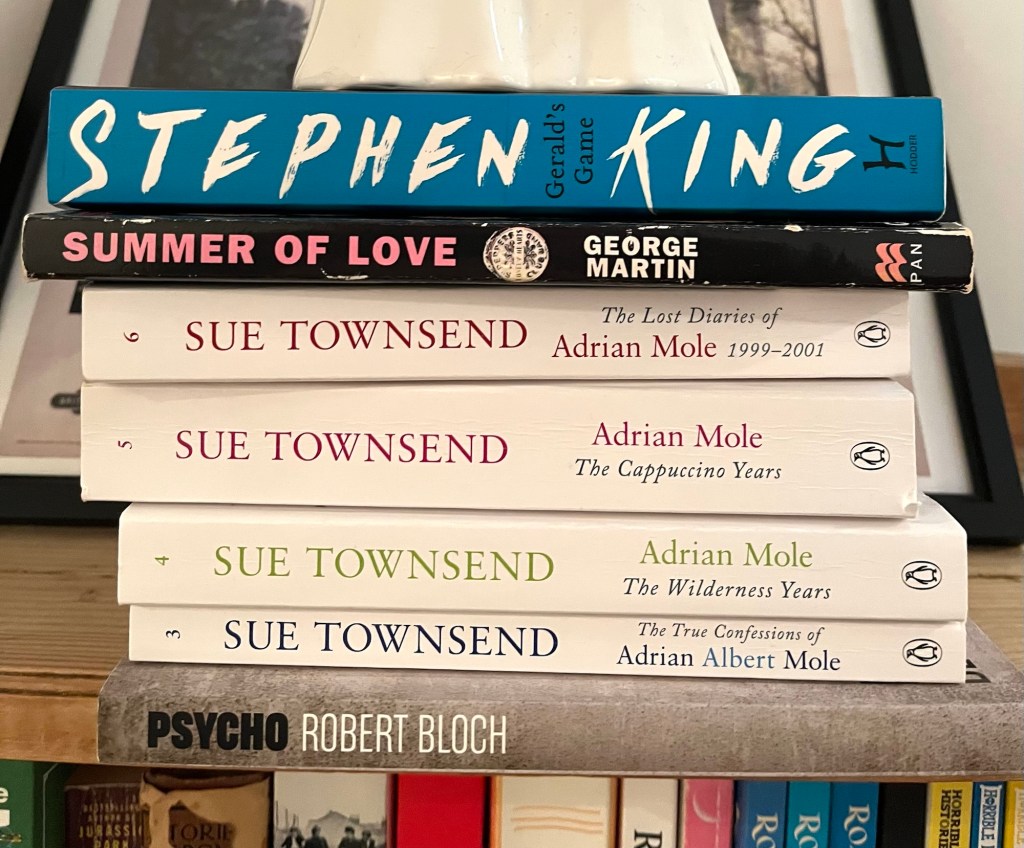
24th October, 23:38. Soon, the clocks will turn back. Truly, the most magical night of the year. Here you go, an hour, gratis. The wind is literally shaking our living room. The cats are shrieking and chasing each other like they know what’s about to happen. I actually feel wide awake. I am on the right side of the flu, after two days off work. My sleep schedule has been erased. On Thursday, I fell asleep at 17:00 listening to Jane Eyre and woke up at 19:12. Helen Burns, I feel you, girl! Tonight is my opportunity to catch up on some reading. I have been convalescing with Gerald’s Game by Stephen King. This feels good: staying up late with a scary book. As the kids might say, it’s giving 127 Hours. Those kids! They say the craziest things. I have only read one other Halloween adjacent book this October, unless everyone is dressing up as Adrian Mole next Saturday, in which case I’ve read way more.
31st October, 4:07. Soon, they will break down the door. I have no doubts about it. Just my luck! I can’t decide if it’s better to wait in the kitchen, or here in the hallway by the door. But then the first Adrian comes through and we’re standing face to face. He nods apologetically and worms past me, then through into the living room. A few more Adrians follow him. Somehow they have not woken Alice, or disturbed the cats too much, although when I find a line of Adrians on the settee, I see Scrooge nuzzling between a set of legs, trying to get cosy. This is unusual: as a rule, Scrooge is scared of all visitors. ‘Is it trick or trick?’ I ask, searching for some reason why the Adrians have appeared. But one of them starts on about the Norwegian leather industry and I realise we are lost. I say, ‘You’ve invaded my brain.’ I wince. Their faces are so readable, I could hardly look away if I wanted to. It’s hopeless.
Psycho by Robert Bloch (1959)
If you know me you know that Psycho is my favourite thing ever, more than Twin Peaks, the Beatles, Daphne du Maurier, or even probably chocolate in all its mellifluous forms. I first read Psycho by Robert Bloch last Halloween. It is impossible not to compare it to the film, and that is part of the fun. It it strikingly different in parts, but the film lifts certain scenes wholesale, like the ending:
She sat there for a long time, and then a fly came buzzing through the bars. It lighted right on her hand. If she wanted to, she could reach out and swat the fly. But she didn’t swat it. She didn’t swat it, and she hoped they were watching, because that proved what sort of person she really was. Why, she wouldn’t even harm a fly. (pp. 185)
Well, maybe not wholesale. The perspective is different. I watched an interesting and impassioned argument for the book a while ago, linked below. I like the book, especially the opening movement, which is the biggest departure from the film (it’s the other way round, of course, but anyway). The famous shower murder is different. The irony is not sad, as in the film, but callous: “Mary started to scream… a hand appeared, holding a butcher knife. It was a knife that… cut off her scream. And her head.” (pp. 39). The book has none of the film’s elegiac quality, but it is economic and frightening in a different way.
The True Confessions of Adrian Mole by Sue Townsend (1989)
This is a hodgepodge book. But a hodgepodge can be nice: just look at the humble stew, people! True Confessions is split into three main sections: a collection of Adrian Mole pieces, distinct from the diary entries, but a welcome change of pace after reading Secret Diary and Growing Pains back to back; a selection of travel writing and articles by Sue Townsend, including a long section about a trip to Mallorca which was my favourite; and finally, the highlight of the whole book, an Adrian Mole style diary by one Margaret Hilda Roberts, aka the Witch-King of Angmar. Now, if that sounds like a lot, it is, and this is probably one for Mole completionists. I hate it when people say that about something I haven’t read, though. Oh, so this is just for the fans? I’m gonna read it even harder, then.
Adrian Mole: The Wilderness Years by Sue Townsend (1993)
Having read the majority of the Mole books now, I’d say this is the underrated entry. We join Adrian in Oxford in his early twenties. He is living with (but crucially not going out with) Pandora. He’s working for the Department of the Environment under the officious and adulterous Mr Brown. A good portion of the novel is devoted to Mole’s struggle with his work-in-progress novel Lo! The Flat Hills of My Homeland:
6:00pm. Sink still blocked. Worked for three hours in the kitchen adding vowels to the first half of my experimental novel, Lo! The Flat Hills of My Homeland, which was originally written with consonants only. It is eighteen months since I sent it to Sir Gordon Giles, Prince Charles’s agent, and he sent it back, suggesting I put in the vowels. (pp. 19)
The novel moves from Oxford to Leicester as Adrian loses his job and his room. This move means we get back to what the Mole series is all about: the relationship between Adrian and his mother. There is a very touching moment when Mum reads Adrian’s manuscript, derides it, but then when Adrian cries to the point of dehydration she takes back what she said and consoles him. There are some lovely details in his ‘home’ section: “… the encrusted neck of the HP sauce bottle…” (pp. 177). I think I like this book in particular now, because it is the last time in the series Adrian is younger than I am. That won’t be true for long, mind. Translation: I’m nearly fucking thirty.
Adrian Mole: The Cappuccino Years by Sue Townsend (1999)
The Cappuccino Years was serialised on Radio 4 recently (it might have been a repeat) and I listened to it walking through the park, hungover. I ended up on the beach: one of the things I like about living where we live is you’re never far from a tree, or a pier. Cappuccino Years is the turning point in the series. Adrian is an adult.
I have reached my prime without noticing it or enjoying it. I am only a few short decades away from being unable to cut my own toenails. (pp. 129)
This is the point in the series when Townsend makes decisions which lead to various dead ends. (Offally Good being a prime example – a funny idea that never takes off.) But such is life: you can’t turn back the clock. The most important part of the book is the addition of William, Adrian’s five-year-old son. Adrian Mole: single parent. This is the heart of the book. At one point in the story, Williams ends up in hospital, having lodged a coffee bean into his ear.
When the decision was made to operate I turned to my mother and said, ‘I hold Ivan Braithwaite responsible. It was he who introduced the coffee bean to Wisteria Walk.’ (pp. 249)
The clincher is this: on waking from his operation, William cries for Adrian’s mum, Pauline, and not Adrian. “I now realise that I’m not the most important person in his life, as he is in mine.” I found this section very moving. As a whole, though, I don’t think Cappuccino Years keeps the promises made in its long opening section, in which Pandora is elected as an MP, becoming one of Blair’s Babes. In fact, the novel misses Pandora. Life has gotten in the way. A new day has dawned, has it not?
The Lost Diaries of Adrian Mole, 1999 – 2001 by Sue Townsend (2008)
This book is a headache for anyone with a penchant for continuity. Published after the next book chronologically, Weapons of Mass Destruction, The Lost Diaries contradicts parts of that book and the proceeding books. For example, Ivan Braithwaite dies on honeymoon in Weapons, but in The Lost Diaries, he’s around and kicking long after his honeymoon, worrying away in his computer nook. But the Mole books are a bit like this overall: they can be messy, but in that way they are reflective of life. But there is a repetitious quality to The Lost Diaries which irked me. Adrian wonders, “Are pensioners to be my albatross? I can already feel Mrs Wormington’s liver-spotted hand around my neck.” (pp. 72). This is a thought that we have seen word for word in a previous book. The standout in this book is Pamela Pigg: one of Adrian’s more unfortunately named girlfriends, and a cousin (not literally) to the more rounded and interesting Marigold Flowers.
Summer of Love: The Making of Sgt. Pepper by George Martin (1994)
Man cannot live on Mole alone. This book was a charity shop steal at £3. I first heard about it on Your Own Personal Beatles and I’ve wanted to read it ever since. In short, it is the making of Sgt. Pepper from George Martin’s point of view. What it reveals about George Martin’s pomposity is interesting. There are interesting moments of moralising, too: “Drugs and alcohol tend to be abused when people dislike the reality they are living through. Sorry, but it’s the truth.” (pp. 111). It’s the ‘sorry’ that’s particularly biting. Well, sorry, George, but there’s a bit in this book where you say Edward Lear wrote Jabberwocky. It was Lewis Carroll, you idiot! This is a very quotable book, bottom line.
Every time I go on about the primitive state of recording technology in the mid-sixties, I feel like Baron Von Richthofen describing the Fokker Triplane to a group of Concorde pilots. (pp. 22)
Despite this flirtation with the Partridge-esque, there are moments of luminosity:
For John, the vision was always better than the reality… That was his life. (pp. 24)
Reading this book reminded me of a fascinating documentary from 2007, which I watched at the time, aged ten, in which contemporary bands remake Sgt. Pepper using the original recording equipment. The Kaiser Chiefs section is almost unwatchable. Ricky Wilson cannot sing ‘Getting Better’. I’ve included a link to the doc below.
Gerald’s Game by Stephen King (1992)
My first Stephen King. Go figure! I wasn’t sure if I would finish this book. I came to the halfway point and wondered if I was engaged at all. Then I went at it in one big chunk. I was sold. The premise is a peach: married couple retreat to their summer lake house, introduce handcuffs to spice things up in the bedroom, but before things can get going the husband has a heart attack, leaving our main character handcuffed to the bed, with the keys at the other end of the room. Crucially, this is pre-iPhone. There’s no asking Siri to call 911, or anything like that. My least favourite part of the novel was any business around getting a sip of water, trying to manoeuvre on the bed, or basically anything to do with trying to escape from the situation. Fortunately for me, King is not very interested in this either, and the novel becomes a meditation of memory, prelapsarian guilt, sex, and fear. Unfortunately, there is a fifty page epilogue I could have done without. It should have ended with the car: I’ll say no more.


Leave a Reply